How to Choose the Right CNC Router for Your Manufacturing Needs
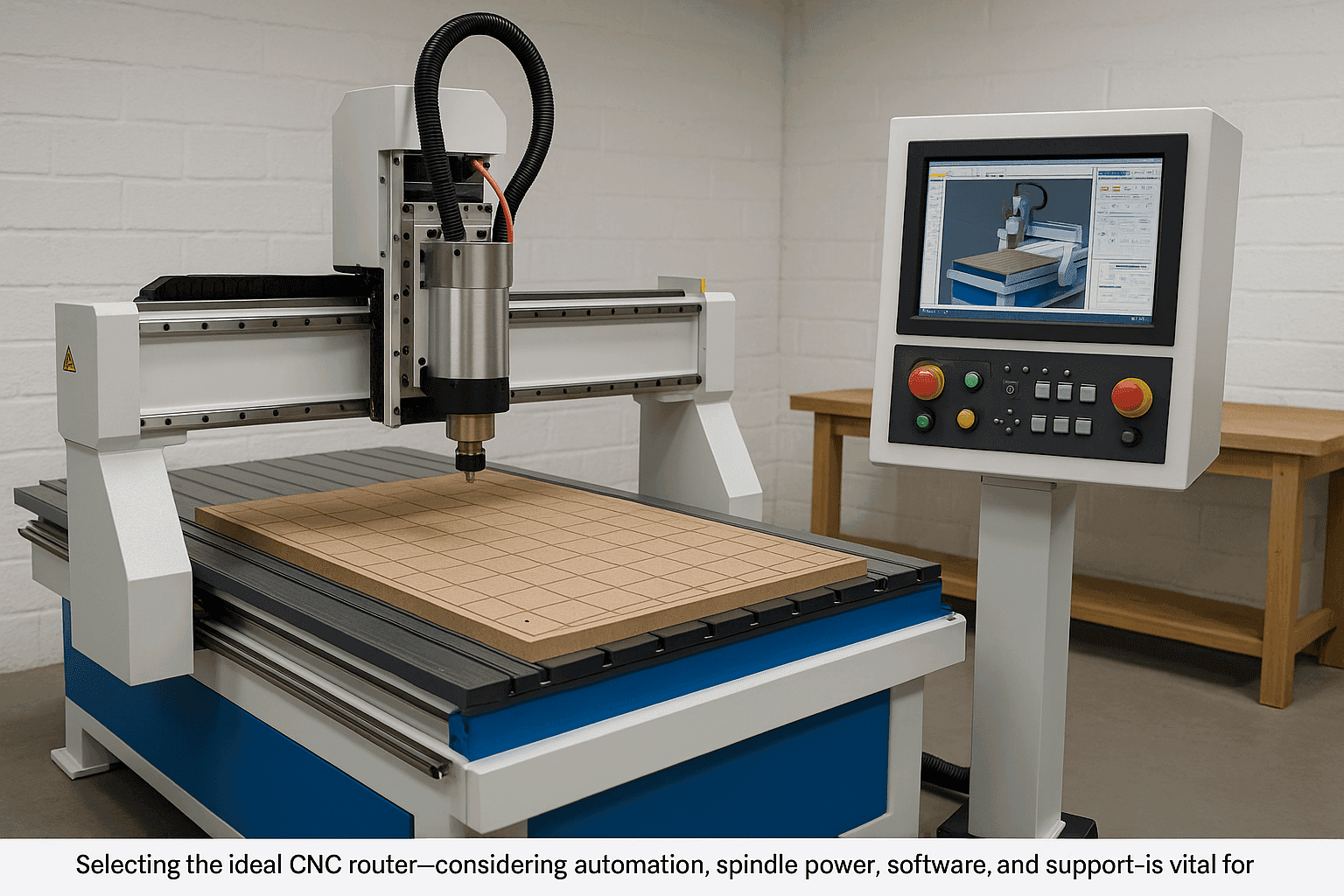 How to choose a CNC router in ten steps: application, bed size, spindle, software, automation, build quality, support, price and return on investment.
Selecting the right CNC router for your UK-based manufacturing or workshop operation involves careful balancing of functionality, cost, and long-term support. Whether you’re a small artisan or a large-scale producer, this guide will walk you through all critical factors to ensure you make a confident, well-informed choice.
1. Understanding the CNC Machine Full Form and Basics
CNC stands for Computer Numerical Control-a technology where machines are guided by digital instructions. A CNC router uses this precision control to cut, carve, and shape materials like wood, plastics, composites, aluminum, and even foam. Before making a purchase, it's essential to know what CNC means and what the different types (2.5‑axis, 3‑axis, 4‑axis, 5‑axis) can do for your projects.
Related reading: see a production example, the Micromax 2030 L ATC, or browse all CNC routers.
2. Identifying Your Application and Material Type
Start by asking:
- What materials will you regularly machine (e.g., hardwood, acrylic, aluminium)?
- What size and thickness are typical?
- How complex are your designs-straight cuts, 3D carvings, or undercuts?
For example, cabinet manufacturers benefit from a spacious bed and automatic tool changes, while signage firms may prioritise high-speed spindles for intricate cut-outs.
3. Matching Project Size to Machine Bed
Machine bed dimensions should exceed your max sheet size. A 4 × 8 ft machine suits most timber sheetwork; larger formats (2 × 3 m or even 6 m beds) support big bathtubs, yacht panels, or one-off items common in boat, door, or trailer fabrication [fyneboatkits.co.uk+1opuscnc.co.uk+1]. Plan for future growth: slightly oversized is better than cramped.
4. Spindle Power, Speed & Tooling
Spindles-measured in horsepower (HP) or kilowatts (kW)-determine cutting power. For tougher materials like aluminium, go for 5–9 kW; wood and plastics often need 2–4 kW. Consider:
- Automatic tool changer (ATC) for production efficiency.
- Spindle speed range for different materials.
- Cooling options (air-cooled vs water-cooled).
A UK-installed Pegasus 2030 ATC had a 9 kW HSD spindle and 12‑tool changer, ideal for cabinetry and furniture making [opuscnc.co.uk].
5. CNC Software: Compatibility & Workflow
Your CNC software is the bridge between design and execution. You’ll typically use:
- CAD (e.g., Autodesk Fusion 360, SolidWorks) for design.
- CAM (e.g., VCarve Pro, SheetCAM) for toolpath generation.
- Controller Interface on the router (Fanuc, Syntec, Mach3, LinuxCNC).
Ensure your machine is compatible with your existing CNC software, and confirm whether these come included or need to be purchased separately.
6. Automation vs Manual Operation
Hand-operated machines offer simplicity, but modern shops need:
- ATC systems to switch bits mid-job.
- Vacuum or zoned tables to secure odd-sized sheets.
- Automatic probing for precise alignment.
Such features save time, reduce errors, and increase output-key for tight UK lead times and quality standards.
7. Quality of Components & Build
Look for machines with:
- Heavy-duty welded gantry to resist flex.
- Linear rails and ball screws for accuracy and durability.
- Servo motors and quality drives for consistent positioning.
- Dust extraction ports to keep the workspace clean and parts clear.
These build-quality measures lead to longer-lasting performance and lower maintenance costs.
8. After-Sales Support & Warranty
In the UK, good support access is vital:
- Onsite support and remote diagnostics.
- Training for CNC Software, CAD/CAM, and machine operation.
- Spare part availability and warranty coverage.
Examples like Opus CNC and Fabertec UK offer 24-month warranties, free software licenses, and ongoing technical support [fabertec.co.uk+2opuscnc.co.uk+2fyneboatkits.co.uk+2].
9. CNC Machine Price UK & Affordability
Laser-focus your budget. In the UK, expect:
- Entry-level desktop routers: £5k–£10k.
- Mid-range ATC routers (2 × 3 m, 9 kW): £25k–£60k.
- Production-grade machines: £60k+.
Prices reflect features, quality, and support packages. Review total cost: purchase, accessories, installation, training, and future upgrades.
10. ROI: Precision, Efficiency & Productivity
Investing in the right CNC router pays off by:
- Reducing labour hours.
- Raising cutting accuracy and repeatability.
- Enabling complex cuts and multi-station production.
- Scaling up output to handle larger orders.
This drives quicker ROI and boosts your manufacturing capacity.
Frequently Asked Questions
Q1: What impacts Price CNC Machine most?A: Features like bed size, spindle power, ATC, software included, warranty, and build quality dictate cost.
Q2: How do I choose CNC Software?A: Pick software compatible with your file types and shop skills; value CAD/CAM training and UK support.
Q3: What’s the CNC Machine full form and difference from CNC router?A: CNC = Computer Numerical Control. A CNC router is one application of CNC, tailored for cutting, carving, and shaping.
Q4: Is automation worth more money?A: Yes. ATCs, vacuum tables, and probes reduce manual tasks and boost throughput.
Q5: Can a UK workshop buy CNC Machine Price UK with financing?A: Yes-many UK suppliers offer leasing, finance deals, or rent-to-buy options.
Q6: How much maintenance do CNC Routers need?A: Regular cleaning, lubrication of rails and screws, spindle checks, and software updates help maintain precision and longevity.
Conclusion
Choosing the right CNC router involves more than price. Consider material types, spindle power, automation features, software compatibility, build quality, and local after-sales support. Carefully assess your UK production environment to find a machine that delivers accuracy, reliability, and ROI.
With the correct CNC router, you'll enhance precision, speed up production, and open new product possibilities-all while maximising value on your investment.
Ready to Upgrade Your Workshop?
Tell us what you're cutting and where - we'll size the right machine and get you a quote fast.