From Design to Precision Cut: How CNC Machinery Delivers Accuracy Every Time
In today’s competitive manufacturing world, precision is no longer optional - it’s essential. Whether you’re producing custom joinery, intricate signage, furniture components, or aluminium fixtures, the ability to go from a digital CAD design to a flawlessly cut final product can make the difference between success and failure.
This is where CNC (Computer Numerical Control) machinery excels. From the initial concept to the final cut, CNC technology ensures repeatable accuracy, speed, and efficiency that manual processes simply can’t match.
In this guide, we’ll walk you through how CNC machinery delivers precision at every step, and why businesses across the UK and Ireland are investing in this technology.
1. It All Starts with the Design
The process begins with CAD (Computer-Aided Design) software. This is where your vision takes shape, whether you’re creating a single bespoke item or preparing for a large production run.
Related reading: explore the CNC routers and woodworking machinery behind this accuracy.
Modern CAD software allows designers to:
- Create detailed 2D and 3D models of their product.
- Adjust measurements down to fractions of a millimetre.
- Simulate the machining process before any material is cut.
This not only eliminates guesswork but also saves materials and time by catching potential errors early.
2. CAM Software Transforms Design into Machine Instructions
Once the CAD model is ready, it’s imported into CAM (Computer-Aided Manufacturing) software. This software translates your design into G-code - the language CNC machines understand.
At this stage, the operator can:
- Set cutting speeds and tool paths.
- Choose the type of cutter (end mill, router bit, drill, etc.).
- Define the cutting depth and feed rate for each pass.
This ensures that every movement of the CNC machine is precisely calculated for optimal performance.
3. Machine Setup: The Foundation of Accuracy
A CNC machine’s accuracy is only as good as its setup. Skilled technicians prepare the machine by:
- Securing the material firmly on the work table.
- Installing and calibrating the correct cutting tools.
- Verifying that the machine’s axes are perfectly aligned.
High-end machines, such as those equipped with automatic tool changers (ATC), can swap tools in seconds, reducing downtime and keeping production moving smoothly.
4. Precision Cutting in Action
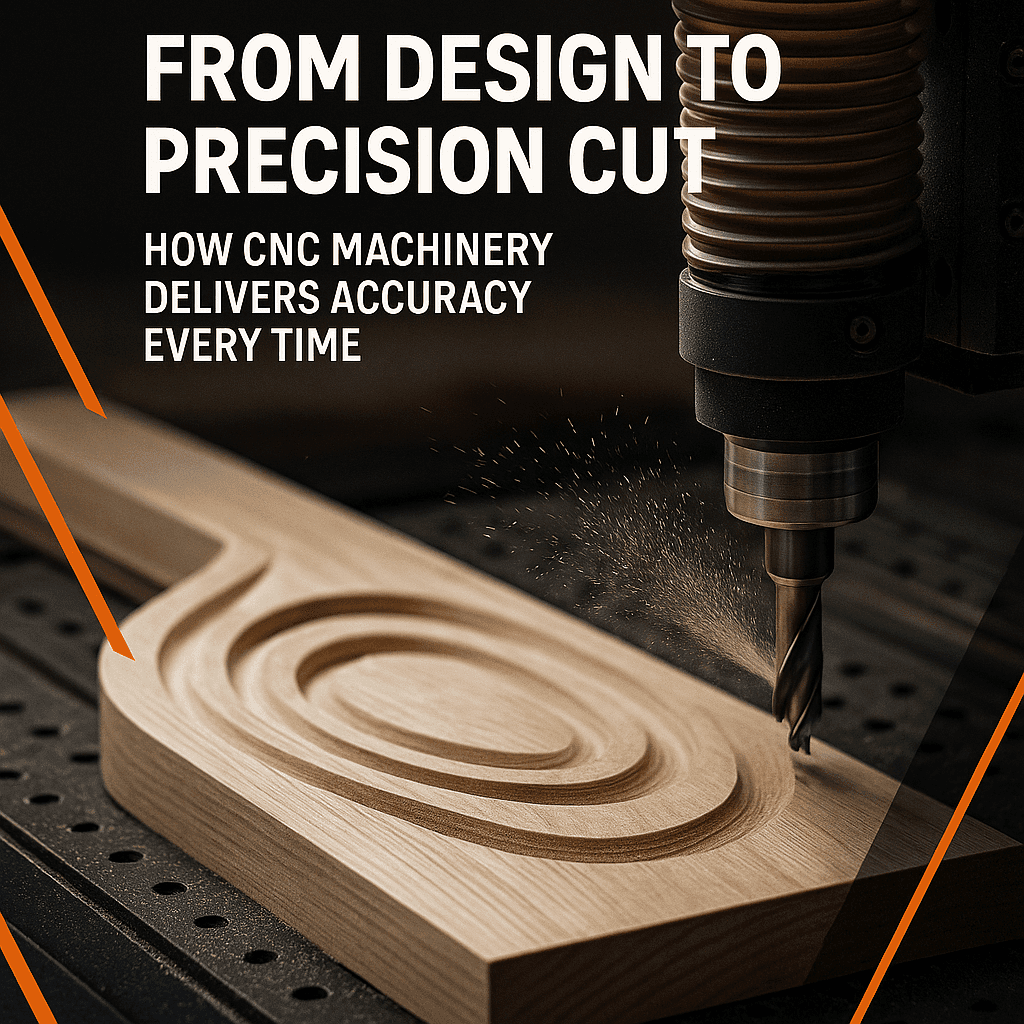
Once the machine starts, every movement is controlled by the G-code - meaning the cut is not dependent on human steadiness, but on computer precision.
Benefits include:
- Micron-level accuracy on complex cuts.
- Consistency across hundreds or even thousands of identical parts.
- Complex geometries that would be impossible to achieve manually.
Whether you’re cutting solid wood, MDF, aluminium, acrylic, or composites, CNC routers and milling machines can achieve clean edges and exact dimensions every time.
5. Quality Control: The Final Check
Even with automated precision, quality control remains essential. Many CNC workshops use digital measuring tools and templates to ensure each piece matches the original CAD design exactly.
Some advanced machines even feature in-process probing systems that check dimensions during the machining process - correcting any deviation automatically.
6. Why Precision Matters for Your Business
In manufacturing, precision equals profit. Inaccurate cuts lead to:
- Material waste.
- Rework and delays.
- Customer dissatisfaction.
By using CNC machinery, you can:
- Reduce waste and maximise yield from every sheet or block of material.
- Deliver projects faster, with minimal post-processing.
- Increase customer confidence with consistent quality.
Real-World Example: From Concept to Delivery
Imagine a client requests a set of bespoke kitchen cabinet doors with a unique curved design.
Without CNC:
- Manual cutting requires extreme skill.
- Slight deviations in each door create visible inconsistencies.
- Project completion is slower and less cost-effective.
With CNC:
- The curve is modelled once in CAD.
- The CNC router reproduces it with perfect uniformity across every door.
- The final product is flawless, delivered faster, and with reduced labour costs.
7. Future Trends in CNC Precision
CNC technology is constantly evolving. In the coming years, we’ll see:
- AI-assisted tool path optimisation for even faster machining.
- Hybrid machines that combine milling, routing, and laser cutting.
- Advanced sensors for real-time error correction.
Investing in CNC machinery now positions your business to stay competitive as these advancements roll out.
Final Thoughts
From the moment a design is conceived to the instant the final cut is complete, CNC machinery ensures unmatched precision, repeatability, and efficiency.
At Micromax Machinery Group Ireland Ltd, we supply state-of-the-art CNC machines to businesses across the UK and Ireland - helping joiners, sign makers, furniture manufacturers, and fabricators produce exceptional work with minimal waste.
If you’re ready to take your production to the next level, explore our range of CNC routers, milling machines, and automated solutions.
Ready to Upgrade Your Workshop?
Tell us what you're cutting and where - we'll size the right machine and get you a quote fast.